

Irregular Regulators
Quis custodiet ipsos custodes?

Who watches the watchers?
A phrase we hear a great deal but in these dystopian times, one that we should pay more heed to.
The Latin — Quis custodiet ipsos custodes? — likely comes to us from the Roman poet, Juvenal’s Satires, via a 1989 episode of Star Trek the Next Generation. Of course!
Literally translated, it means “Who will guard the guards themselves?” or “Who will watch the watchmen?” Its original context dealt with the tribulations men faced in controlling their wives. 🙄
Juvenal wrote about the guards, sometimes employed by wealthy Roman men to stop their wives from cheating on them; often resulting in the women reaching out to the guards themselves for their fun. This led to the phrase, who will watch the watchmen.
The implication is that the wife may simply seduce the guards, making the whole idea of surveillance pointless.
So far, so horrifically misogynistic.
As far back as the second century BCE, Polybius wrote that stable government requires mutual supervision between institutions — a more political framing of the concept, and in the 17th century was adopted by Montesquieu in France to promote his theories of checks and balances at a governmental level.
He posited the separation of powers and dividing the country into three distinct branches that could regulate each other: legislative, executive, and judicial — each held by different bodies so that “power should be a check to power.”
For decades, in western democracies at least, we have accepted that our government and its checks and balances are adequate, that they held enough power and regulatory might, to hold our society together. But is that the case today? Has the internet ripped that centuries old framework apart? I’d argue that it has.
This article has been bubbling away in the back of my mind for a while but has finally burst forth after hearing an interview with Dame Melanie Dawes, the boss of Ofcom, on LBC last week. The station launched an ‘online safety day’ three years ago and, to celebrate the anniversary, managed to snag an in-depth interview with the country’s most wide-ranging regulator. I’ll circle back to this insane conversation in a mo. but it’s guessing game time.
How many regulatory bodies do you think the UK currently employs to look after us? 10, 20, 50?
The answer is 112.
I considered a table or graphic to list them all, but it would be too large, so if you head to this Wikipedia page,1 you can feast your eyes upon the entire framework of our regulatory bodies. There are 24 just for our health service alone.
One hundred and twelve separate regulators to oversee our society; hugely fractured and overblown from Polybius or Montesquieu’s original, simple proposals.
The sheer scale of these institutions is mindboggling, and it hints at the issues we face across the country. Government contracts out small sections of its remit to these institutions in order to keep things running smoothly. And that all worked, to a point, until very recently; and by very recently, I’m talking about the last twenty years — ish.
Anyone in class care to venture a guess as to what changed things? Why are things now so much more difficult to police?
If you said the internet and, specifically social media, you can collect your gold star at the end.
As I’m sure we’re all aware, the rise of the robots is upon us, but before we reach that particular scene in the movie, we have to build up to it. I contend that this is where we find ourselves in 2026 — the preamble before dystopia. The storm before the calm.
Social media has rent our societies asunder — from our obsessive attachment to our pocket rectangles, to our need for more and more data, be it real or not. We cannot live without constant input. This is the storm.
With this need for input comes our thirst for news — and this is where I’m going to leave all other regulators aside and focus on one in particular — Ofcom. I’ll return to the broader picture at the end, but I’m choosing Ofcom as my regulator de jour because they are responsible for much of our lives now; our input. OUR PRECIOUS DATA.
Before 2003, Ofcom didn’t exist, there were five bodies that oversaw media, TV and radio, but with the 2002 Office of Communications Act, it was brought into life to provide a more centralised position on our media landscape and to manage the flourishing digital age. TV was overlapping with the internet and this needed to be managed.
It’s role as an enforcer of broadcasting rules has always been central to its purpose, and this was strengthened with the introduction of a broadcasting code to set standards for TV and radio across the UK. As years rolled onward it was becoming responsible for more and more factions including, broadband contracts, the post office, mobile phone networks, TV on demand and eventually streaming. It was bulging at the seams of responsibility and, as the digital world started to overtake the analogue one, began to struggle.
Today Ofcom is responsible for:
TV & radio broadcasting
Telecoms (mobile, broadband, landlines)
Postal services
Online platforms & safety
A snappy little list of four things, but if you break down each one of those into its component parts, it’s unimaginable; the last one alone is effectively just ‘THE INTERNET’. Who could possibly dare to dream about policing the entire internet? And it’s this that has brought me to this article — the sheer scale and speed required to regulate the online news media world is mind-blowing, but when social media is brought into the mix, I would say impossible.
I wrote a couple of weeks ago for West England Bylines2 about media influence and how it’s almost impossible to be free from it. In that article, I used a specific case in the Telegraph of an entirely fabricated story about some people who didn’t exist. It was written to attack a government policy but was found to be fictitious from start to finish. It took IPSO [Independent Press Standards Organisation] almost an entire year to issue a ruling on that fabricated story. A year! And when they did issue a formal ruling, the punishment meted out was to publish a retraction and apology on their front page for 24 hours — they did, but it was buried six pages below the headlines.
And this is the point of this entire article. Are regulators fit for purpose in the digital age? The answer is, of course, a resounding … no.
I recorded an episode of our podcast3 with the excellent Emma Monk this week when we chatted about these news outlets, especially the Telegraph, editing articles on the fly when they are found to have lied or created unfounded stories. People only read an article once, so if they’ve already read a fabricated article, the chances of them returning to see the corrected version is zero. The damage has already been done.
Check out Emma’s Substack here, by the way:

So you can see that it is impossible to constantly chase these news stories when they’re effectively policing themselves. As an investigator, I am often drawn to Wayback Machine and archive.today because they hold a record of edited versions of stories — it can provide vital context and data. Ofcom will not do that, they will only react to very specific information. Information that, by the time an investigation is opened, might have been erased, edited or updated to look normal.
When we bring in social media, I’d say that Ofcom has absolutely no chance at all. The insane speed at which our feeds update makes it akin to pinning smoke to the wall. Platforms such as 𝕏 and TikTok run their algorithms at such pace that you may never see the same post twice, but the sinister side of the former has reared its ugly head recently and is worth taking a look at.
Grok, Elon Musk’s pet Ai chatbot, allows users to create images from scratch or from a photo uploaded to the interface, it will then alter said photo to the user’s prompts. This made the news last month when millions of creepy men began to virtually undress women and post the results in their 𝕏 feeds. This, understandably, caused outrage and a real, palpable sense of fear among women on and offline. How was this permitted? Aside from sending millions of users scurrying off the platform, questions were raised and, eventually, the government and Ofcom stepped in. They opened an investigation and issued a threat to Musk that the UK would not allow this gratuitous content, claiming that they would shut down the social media platform in the UK if compliance was not swift.
At first, Musk laughed it off and tried to dodge the issue, as is his wont. But he did make some changes and restricted the use of Grok to its premium [blue tick] subscribers. A step, sure. But not enough. Shockingly, anyone with a blue tick can still manipulate photos of women and undress them. This highlights the real lack of power of our regulator. It can force some changes but, in reality, the platforms will always win. Our governments seem terrified of upsetting the tech-bro puppeteers.
The other factor in social media is sheer volume. I asked ChatGPT to estimate how many news articles are published every day in the UK — it thought for a bit and then produced a ballpark range of 25,000 to 50,000. Every day in the UK alone. The source4 it gave me is fascinating; it’s from 2024, so things have only increased since then.
That’s ‘regulated’ news, not social media.
It’s ballpark estimate for social media is 5-10 billion posts every day, worldwide.
According to a report by Westco Communications,5 52% of adults get their news from social media with, staggeringly, Facebook being the dominant source.
And here we have the monumental struggle that Ofcom faces; how could it ever be expected to monitor this amount of data and traffic? It can’t. With more and more people turning to social media as their chosen source of news, it leads to more and more false information being read as the truth. Fake news, as Trump loves to call it.
The lack of scale at Ofcom is being exploited by bad actors, especially in our political sphere; more and more we see those on the far-right, especially, spreading deliberate disinformation to stir up anger and hatred. People become entrenched in their views and believe the accounts on 𝕏, rather than credible news outlets. We’ve seen it time and time again — the Southport murders, the rioting that followed and more recently, a mentally ill man on a train attacked passengers, but, by the time the legacy news had got the true story out, the bad actors on 𝕏 had already invented the narrative that it was an Islamist terror attack. It was not. People would not believe the reality of it, though.
People, to this day, still believe that the Southport murders were perpetrated by a Muslim terrorist because Nigel Farage and Andrew Tate said that it was. A falsehood that spread at the speed of social media. One that was never acted upon by Ofcom.
I’ll just bring in one more facet to the monumental pile that Ofcom has to face — GB ‘News’. The news channel that isn’t.
GB ‘News’ effectively runs as a Reform UK promotional TV broadcaster. They employ the services of Lee Anderson, Matt Goodwin, Robert Jenrick and of course Nigel Farage, among many other Reform employees or members.
This presents a particular challenge to the regulator, as the rules state that serving politicians may not present news broadcasts. GB ‘News’ seems to be able to circumvent this by saying that they’re not a news channel; not really. Despite the name and continual claims that they are the leading news channel in the UK [they are not].
But again, the speed and scale of this operation outfoxes Ofcom at every hurdle. What chance do they have to investigate a case of deliberate lying by a politician presenting on a news channel, when they have received another 300 complaints about 300 new things before the ink has even dried on the title of their first investigation?
Occasionally, GB ‘News’ is found guilty of an infraction, and they employ the same tactic as the Telegraph, by issuing a retraction in the dead of night or buried deep within their website. Not good enough.
As I finalise this piece, there has been an excellent article published in New World6 today, by the peerless Alan Rusbridger, that backs up all that I’ve said. They’ve done the maths, and GB ‘News’ = Reform TV. Have a read.

Ofcom has my sympathies … to a point. They face insurmountable challenges to keep the internet and broadcasters in check, but when I heard the interview I alluded to at the beginning, my solidarity drained away, quickly.
Dame Melanie Dawes told the radio station that they had issued fines to only thirteen social media platforms for infractions, and that several more were under investigation [up to 52]. Only one company bothered to pay the fine issued — an obscure Italian porn website. The rest have totally ignored the penalties and continue unabated. When pressed about this, Ofcom’s boss stated that they weren’t really worried about the fines. That seemed counter instinctual, to say the least, but she went on to say that, despite issuing multiple fines that remained largely ignored, she thought it was having the desired effect.
The effect went unmentioned.
While Ofcom’s boss remained cheery and optimistic, it doesn’t bode well for our online space. Many liken social media to the Wild West or the Gold Rush, and I think this is entirely fair with a caveat. Unscrupulous, dangerous individuals mining for gold, often resorting to violence, outrage and derision. Minority groups being targeted and attacked. Uncontrolled and rapid expansion.
The one crucial caveat I insert into this comparison is that of malicious bad actors — those who make money from fake news and distress, and those who seek to profit politically. The Gold Rush had one strong objective — find that precious resource. Social media has all the bad bits of the that period but with the addition of state backed and individual accounts that only want to sow chaos, create harm and undermine the rule of law.
One further interest of mine is that of the Electoral Commission. They have a far smaller remit, but still falter for the very same reasons laid out above.
Reform UK told the world a year ago that it was going to accept crypto donations, and a month or two later boasted of receiving two. The Electoral Commission still, to this date, has no idea who these donors are. If they exist, they were registered as cash, meaning that they could have come from overseas — a fundamental breach of political donation rules.
Why has the regulator not fixed this monumental, gaping loophole? It’s wide open for the more unscrupulous to exploit. Our media kindly told us this last year, but nothing has moved forward. That lack of speed, fleetness of foot, comes back to bite them.
The use of crypto is the most worrying factor for me in this field. The far-right have been so far ahead of the game that it’s impossible to catch up. Unless crypto donations are totally banned in the UK, the far-right parties will milk the system for all it’s worth. Epstein, Bannon and the far-right leaders have been laying this out for years. I found this little nugget whilst browsing the database.
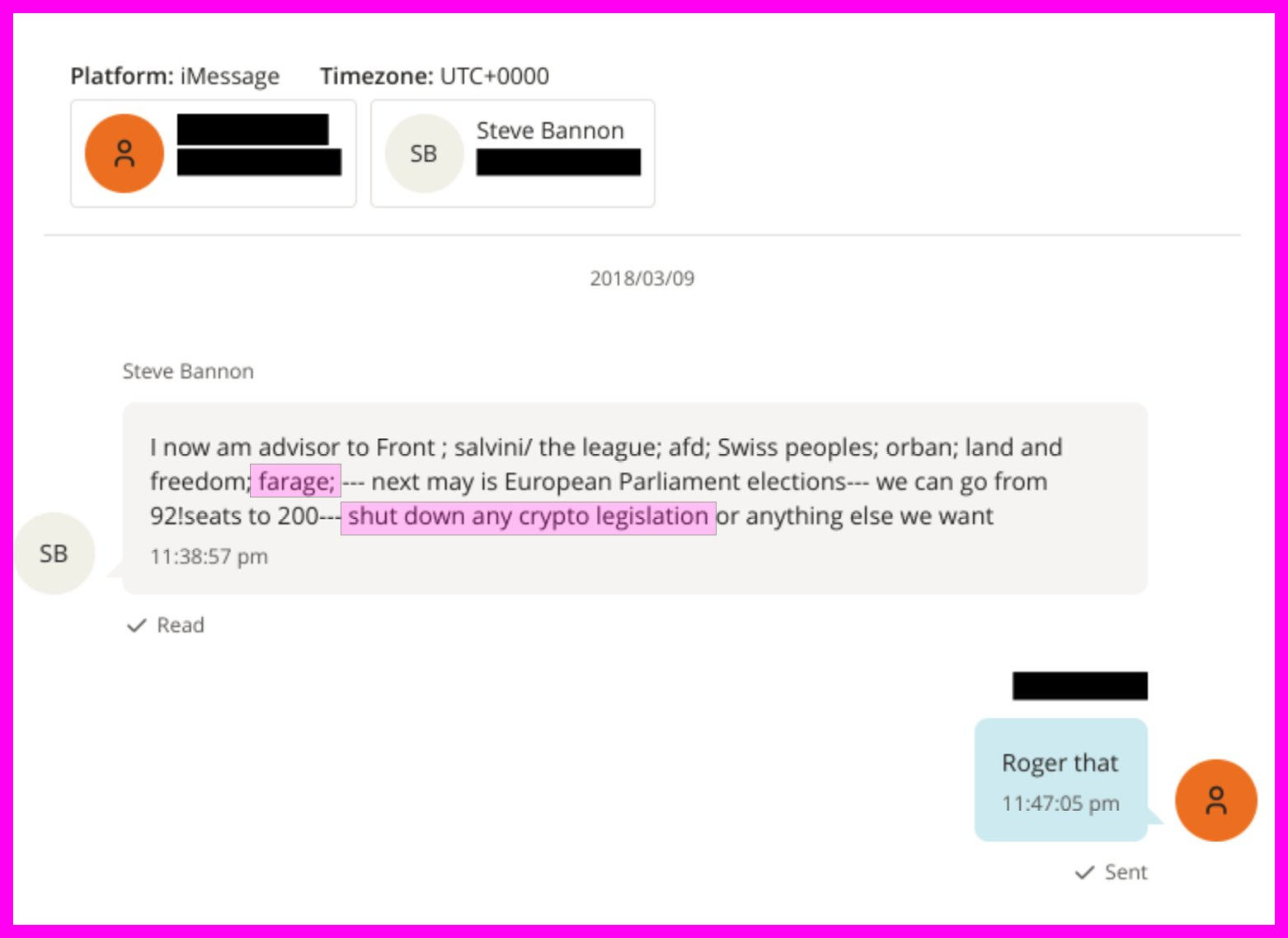
Farage was always part of this plan, so why haven’t the Electoral Commission been more proactive? They do not have the same remit as Ofcom, and this stuff is all out there to be seen in public. Act.
As I said up top, there are 112 regulators in the UK. Many face similar issues. Social media and online services are hampering them severely or rendering them entirely obsolete in some cases.
In my previous article about Palantir, I suggested that it was too late for the government to remove their influence, they are too tightly embedded. Is it too late for our regulatory bodies? Have they missed the Gold Rush?
Palantir Entanglement

Yesterday in the House of Commons, Shabana Mahmood announced sweeping new police powers, including the roll-out of Ai technologies to all police forces in the UK. This got me thinking about one of the UK’s most prolific IT/data infrastructure providers — Palantir Technologies.
Sisyphus was doomed to push a boulder up a hill every day, only to find it back at the bottom when he awoke the next day. This seems like an appropriate analogy to end on.
We have no watchmen to watch the watchers. In fact, the watchers are unable to perform their singular, solitary purpose. A redundant system of checks and balances is leading us to the robots taking control, and I, for one, welcome the peace and quiet our autonomous overlords will bring!

If you have made it to this point, well done — this has been a long old slog. Thank you for reading, I sincerely appreciate it.
I don’t get paid for this stuff, so I have a couple of ways you can help out and support my work and research if you value my honesty and work. Firstly, you can subscribe to my Substack here:
Free or paid is spectacular and you’ll never miss an article. Or you can hit me up on Ko-Fi for a donation or tip to help me with my research and keep me writing.

Please feel free to contact me with any questions or if you think you may have a story. I’m here on 𝕏 @donmcgowan or you can drop me an email, donmcgowan@pm.me. Thank you so much for reading.

Source — West England Bylines
Source — No Holds Barred Pod
Source — InPublishing
Source — Westco Communications